
Hemphill Parole and Probation
Texas divides release decisions, prison records, parole supervision, and probation among different bodies. The Texas Board of Pardons and Paroles decides parole and mandatory supervision. The TDCJ Parole Division then supervises a person who is released under either status. A Community Supervision and Corrections Department, often called a CSCD, handles probation ordered by a trial court. Calling all three systems “parole” can send a request to the wrong office and produce a misleading answer.
A person can leave Hemphill County Jail on probation without ever serving a TDCJ prison sentence. Another person can leave the jail only because TDCJ accepted custody, then later leave state prison on parole. The first exit is a county-custody event. The later exit is a state-prison release. These must be checked through separate records.
| Question | Parole or mandatory supervision | Probation |
|---|---|---|
| Who orders or decides it? | Texas Board of Pardons and Paroles under state law | The court handling the criminal cause |
| Who supervises? | TDCJ Parole Division | The responsible local CSCD |
| Best first record | TDCJ IVSS, parole status, or a focused TDCJ request | Judgment, docket, and later court orders |
| How it ends | TDCJ discharge or other lawful termination | Court completion or discharge record |
- Parole
- Supervised release from state prison before the sentence discharges.
- Mandatory supervision
- A distinct Texas release status based on statutory eligibility, credits, and review rules.
- Probation
- Court-ordered community supervision instead of, or following, confinement.
- Discharge
- The later event that ends a sentence or supervision status.
Verify Hemphill Release Supervision
Start with the event that placed the person in the community. A Hemphill County Jail release record can show bond, time served, court release, or transfer, but it does not serve as a full parole or probation record. If HCSO reports a transfer to TDCJ, the person was not released to the community at that point. For the full named-person search and county record route, use the Hemphill County released-inmate search.
- Identify the last custodian. Ask whether the person left Hemphill County Jail, a TDCJ unit, federal custody, or another jail.
- Check state-prison status. Search the TDCJ Online Inmate Search by TDCJ number, SID, or accurate name details.
- Check state supervision. Use TDCJ IVSS for custody, parole, or mandatory-supervision status and notifications.
- Check the court for probation. Ask Hemphill County's combined clerk for the judgment, docket, and any modification, revocation, completion, or discharge order.
- Request a formal record. Ask TDCJ for the actual release date, supervision status, office, warrant status, and discharge date when a portal does not settle the issue.
Match more than a name. Use a TDCJ or SID number when available, then compare offense, court, county, sentence, and age. A current TDCJ location means that departure from the county jail was a transfer into state custody. A missing search result does not prove discharge because the ordinary TDCJ search is not a full former-prisoner archive.
Note: Record the agency, exact status label, and date checked so a later status change does not erase the context.
Hemphill Parole Office in Amarillo
Hemphill County has no local TDCJ parole office. TDCJ's county directory assigns Hemphill cases to the Amarillo District Parole Office in Region V. The district office is the practical contact for a known parolee or mandatory-supervision releasee and for confirming which supervising office is responsible, subject to lawful disclosure limits.
5809 South Western, Suite 120
Amarillo, TX 79110
Phone: 806-355-9218
Fax: 806-353-9572
The TDCJ county mapping supplies the Hemphill assignment. The Region V directory shows the Amarillo DPO contact used for Hemphill County release supervision.
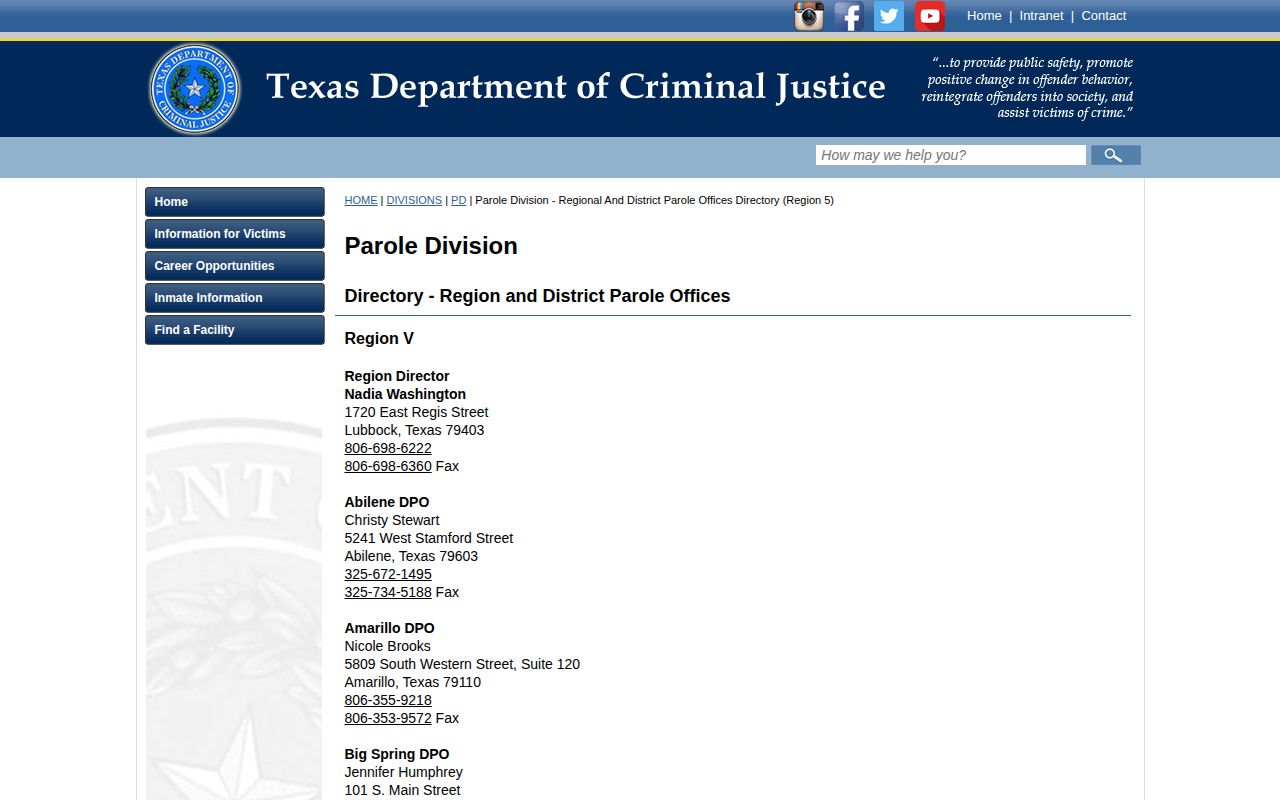
The captured directory confirms the state supervision route. Before calling, have the person's full name, TDCJ number or SID if known, and enough conviction detail to separate similar names.
The Amarillo DPO is not a county probation office. It also is not the Board office that votes parole cases. Those boundaries matter because a district parole officer supervises releasees but does not grant parole or change the court's probation judgment.
Hemphill Release Offices Differ
Hemphill's routing has an unusual source of confusion. The Amarillo Board Office is at 5809 South Western, Suite 200, while the Amarillo District Parole Office is in Suite 120 at the same street address. Similar names and one building do not make them interchangeable. The Board office receives voting correspondence and participates in parole decisions. The DPO manages state post-release supervision.
The Board office phone is 806-359-7656, and its correspondence address is AMBoardCorrespondence@tdcj.texas.gov. Those details do not replace the DPO number for routine supervision questions. Probation remains separate from both. Hemphill's combined County and District Clerk can identify the judgment and responsible CSCD when a court placed the person on community supervision.
Note: Ask the clerk to distinguish the county or misdemeanor file from the district or felony file before requesting probation orders.
The clerk pages do not provide an official public local criminal-case search. Contact the combined office at 806-323-6212 with the name, approximate filing or arrest date, and cause number if known. Request the judgment, sentence, docket, and later supervision orders. Do not rely on a parole office to reconstruct a probation case.
Hemphill Parole Status Records
TDCJ policy PD/POP-01.02.01 identifies useful public-on-request categories. They include supervising officer, identifiers, offense, sentence, court, county, cause number, parole eligibility, release dates, discharge dates, supervision status, and warrant information. A narrow request is more useful than a broad demand. State the person accurately and ask only for the fields that answer the release question.
For a formal request, use the TDCJ online Public Information Act form or email PIA@tdcj.texas.gov. Ask for actual release, parole or mandatory-supervision date and status, supervising office, any public warrant status, and discharge date. Projected and scheduled dates should remain labeled as future or planned dates. Neither proves an actual exit.
The simpler TDCJ email information service can supply current location, offense, incarceration history, conviction data, and projected release information. It is helpful for identity matching, but a focused parole record is stronger for a person who is already outside prison. TDCJ IVSS can add notice of changes, yet its alert is not the originating public record.
Hemphill Supervision Warrants
An absconder is a person alleged to have stopped reporting or otherwise left supervision without authorization. An active warrant or absconder status reflects a post-release supervision problem. It does not erase the fact that the person previously left prison. It also does not prove that the person is now booked in Hemphill County Jail.
No official Hemphill sheriff absconder list was identified. The live Kologik jail roster should not be turned into one. If the question concerns TDCJ parole, request public warrant or supervision status under the Parole Division policy and confirm the supervising office. If the question concerns probation, check the court docket for a motion to revoke, warrant-related entry, modification, or later order, then confirm the responsible CSCD.
Conditions vary by case. At a high level, supervision may require reporting, approved residence or travel, program participation, and compliance with special terms. The controlling order or certificate is the right source. Do not infer a violation merely from a missed online result or an old address.
Hemphill Parole Review Results
Texas does not publish a person-by-person formal parole-hearing calendar because the Board says parole and mandatory-supervision cases do not receive formal hearings. TDCJ identifies an initial case about six months before eligibility and a later review about four months beforehand. An institutional parole officer interviews the prisoner and prepares a summary, then a three-member panel votes in sequence. Two matching votes decide the result.
Check Parole Review Information on the matching TDCJ inmate detail, or call the BPP status line at 844-512-0461 with the name, TDCJ-CID number, and birth date. A denial supplies a next-review date. An approval may require a program or set a later month, and it can change if new information arises.
Read the vote code exactly. FI-1 means release when eligible; FI-2 identifies a future month or year; FI-3R and related codes can require a program; RMS concerns mandatory supervision; NR denies release and sets another review. None is a jail-door timestamp. Actual release must be confirmed afterward through TDCJ, IVSS, the Parole Division, or a release record.
Note: Parole eligibility, a favorable vote, scheduled release, actual release, and discharge are five distinct events in Texas records.
Hemphill Supervision Discharge Records
Physical release is not the last date in many files. A person may leave TDCJ on parole or mandatory supervision and remain under the sentence until discharge. Another person can leave Hemphill County Jail on probation, complete the court's terms later, and never enter state prison. In each case, the discharge or completion record answers when supervision ended.
For state parole, request the TDCJ release date, supervision status, and discharge date together. For probation, ask the combined clerk for the original judgment and the later completion, early termination, revocation, or discharge order. The Hemphill County projected release date explains why an estimate, a scheduled plan, and an actual release must not be treated as the same event.
A court dismissal of one cause does not settle a separate case. A completed county probation term does not prove that a state parole term ended. Conversely, an old public docket does not prove that supervision continues. Identify the legal authority, obtain its current record, and quote the status as written.