
Hemphill Projected and Actual Release
Texas records use several date labels that must not be collapsed. TDCJ defines a Projected Release Date as the date its Classification and Records function projects release if parole does not occur sooner. A Parole Eligibility Date is the first point at which the law may permit consideration. When a plan is finalized, TDCJ can show a Scheduled Release date and Scheduled Release location. Even that schedule can change, including on the planned day.
Discharge is later still. It ends the sentence or supervision. Someone can leave prison on parole and remain under TDCJ supervision for years before discharge. A person can also leave Hemphill County Jail on bond while the court case remains open. Use the word that appears in the source.
A pretrial detainee has no sentence-based projected date. Bond, a court order, dismissal, a new hold, or later sentencing may control the next step. The current Hemphill Kologik roster has a projected-release property in its data model, but sampled records left it blank. That field does not create a county projection service.
Find a Hemphill Release Date
The correct route depends on who has custody. Leaving Hemphill County Jail for TDCJ is a transfer, not a community release. Conversely, TDCJ rules should not be copied onto a short county sentence. Start with the last confirmed custodian and follow the record forward.
- Check current county custody. Use the sheriff-linked roster only to see whether a person is shown in Hemphill County Jail now. Absence alone is not release proof.
- Ask HCSO what happened. Call 806-323-5326 and ask whether the booking ended by community release, transfer, correction, or another disposition.
- Search TDCJ when state custody applies. Use a TDCJ number, SID, or surname plus first initial in the TDCJ offender search.
- Open and match the detail. Compare county, court, offense, sentence, age, location, and sentence-begin date before reading date fields.
- Check the court for a county sentence. Request the judgment, sentence, jail credit, and amended orders from Hemphill's combined clerk.
- Confirm the actual event. Obtain the jail or TDCJ release record rather than turning an estimate into a past-tense claim.
The Hemphill County released-inmate search gives the broader custody-to-record path. For state cases, save the exact label and the date checked. For county cases, ask HCSO and the sentencing clerk for the calculation used in that specific case.
Note: A name leaving the current jail roster can mean release, transfer, correction, or lag, so obtain the disposition record.
Hemphill TDCJ Release Fields
TDCJ's online search is aimed at people currently serving a TDCJ sentence. It is not a permanent archive of every discharged prisoner. Search first by TDCJ number, then SID, then by last name with at least a first initial. A no-result can reflect a query error, intake lag, discharge from the current-search population, or the fact that the person never entered TDCJ.
| TDCJ field | What it establishes | What it does not establish |
|---|---|---|
| Current location | The listed TDCJ placement at the time checked | Future community release |
| Projected Release Date | A present agency calculation | An actual exit |
| Parole Eligibility Date | Potential review timing under the law | Approval or release |
| Parole Review Information | Review status and last vote | Physical discharge |
| Scheduled Release date/location | A finalized release plan | A plan immune from change |
| Actual release or discharge record | A past custody or sentence event | Earlier projected accuracy |
The TDCJ email information service is a useful fallback. Send the full name and seven-digit TDCJ number to pia@tdcj.texas.gov. If the number is unknown, provide exact date of birth or approximate age plus county of conviction. The service lists projected release and incarceration information among its available fields. Use the formal Public Information Act channel for an actual release history or a broader record.
The official email-information page explains that fallback and its identity requirements. It does not supply photographs. For a date question, a focused request for projected, scheduled, actual release, parole or mandatory-supervision, and discharge dates keeps the timeline clear.
Hemphill Projected Release Definition
The TDCJ definitions page is the controlling source for the agency's projected-release term.
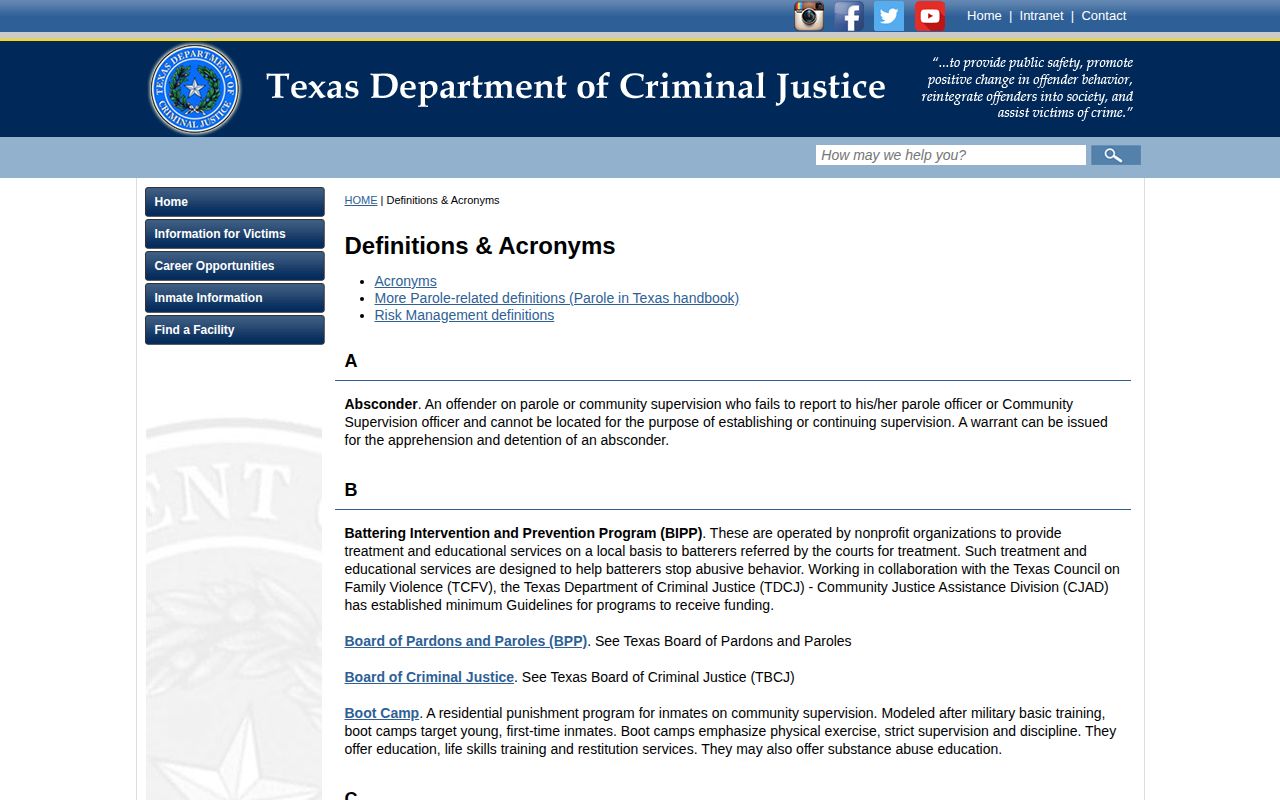
The captured page helps preserve the distinction between an official projection and an actual Hemphill County release event. Recheck the live source because the value and the governing facts can change.
Hemphill Release and Good Time
Texas has no general rule that every prisoner must serve about 85 percent of a sentence. That shorthand should not be imported from the federal system. A Texas date can depend on the offense date, offense category, sentence, good-conduct classification, parole eligibility, mandatory-supervision eligibility, discipline, and Board action.
Government Code Chapter 498 supplies the good-conduct framework. Section 498.003 authorizes classifications and awards. Section 498.004 addresses forfeiture or suspension for misconduct and related issues. Most important, Section 498.005 says good-conduct time applies to eligibility for parole or mandatory supervision and otherwise does not reduce the sentence itself. Credits cannot simply be subtracted from the judicial term.
For a mandatory-supervision-eligible offense committed before September 1, 1996, flat time plus good time can equal the sentence. For eligible offenses on or after that date, those credits interact with discretionary review. A denial can move the projection to maximum expiration or discharge, while a later approval can move it forward again. A person excluded from mandatory supervision will generally have a projection based on maximum expiration and flat time.
Note: Good time affects statutory eligibility and calculations, but Texas law says it does not reduce the sentence itself.
Hemphill Parole Eligibility Rules
Government Code Chapter 508 governs parole and mandatory supervision. Section 508.145 sets eligibility rules. For many eligible prisoners, calendar time plus good time must equal one-fourth of the sentence or 15 years, whichever is less. For Article 42A.054 and other listed serious cases, actual calendar time without good-time credit generally must reach one-half of the sentence or 30 years, whichever is less, subject to the statute's details. State-jail felons do not receive parole.
Section 508.149 lists mandatory-supervision exclusions and provides the discretionary framework for later offenses. Section 508.147 addresses release mechanics. These are system rules, not a safe formula for a public calculator. The offense date and statutory category can change the outcome before sentence length is even considered.
Eligibility is only a chance for review. A favorable FI vote may set a future month or require a program. A denial supplies another review date. Neither outcome proves that the person left a TDCJ unit. Confirm release after the decision through TDCJ, its IVSS system, or the Parole Division.
Why Hemphill Release Dates Change
A projected or scheduled date can move as the legal and custodial facts change. The most reliable explanation is the updated TDCJ record or the county calculation sheet, not a third-party estimate.
| Factor | Possible effect | Best confirmation |
|---|---|---|
| Disciplinary action | Good time may be forfeited or suspended | TDCJ classification and disciplinary record |
| Mandatory-supervision review | Denial or later approval may move the projection | BPP decision and TDCJ detail |
| Parole vote or program | A date may move earlier or wait for a condition | Parole Review Information and release record |
| Detainer or warrant | Exit from one system may lead to another custodian | Releasing and receiving agency records |
| New sentence or court correction | Sentence structure or credit can change | Judgment, amended order, and TDCJ calculation |
| Administrative recalculation | Projected or scheduled labels can update | Dated official search and records response |
A detainer is a request or notice from another authority concerning custody. It can turn a planned release into a handoff. Thus, a Hemphill County jail exit may lead to TDCJ, another county, federal custody, or ICE. Likewise, leaving TDCJ does not prove the person is free of every other hold.
Hemphill County Sentence Dates
No official Hemphill County Jail good-time formula was found. TDCJ's state-prison rules must not be placed on a county detainee. Ask the jail administrator for the calculation record, then ask the combined County and District Clerk for the judgment, sentence, time credit, and any amended order.
The clerk is at 400 Main Street, Suite 203, Canadian, Texas 79014, phone 806-323-6212, and lists weekday hours from 8:00 a.m. to 5:00 p.m. County and misdemeanor files remain distinct from district and felony files even though one combined office serves both. Supply a cause number when possible.
Bond and pretrial release follow a different path. A signed order may precede physical processing, and a posted bond does not supply the final jail-door time. Ask HCSO for release date, time, disposition code, releasing authority, and transfer destination if public. Ask the court for the order that authorized the event.
Confirm Hemphill Actual Release
Future dates are useful for planning, but only a retrospective record confirms the event. For TDCJ, request actual release, parole or mandatory-supervision date and status, supervising office, and discharge date. For Hemphill County Jail, request the booking and release record with date, time, release code, authority, and any public transfer destination.
Texas IVSS uses separate systems for county and state custody. A notification can flag a change, but it is not the official custody record. The Hemphill County VINELink and IVSS check explains the current Texas notification route and why an empty result is not proof of release.
Use precise wording. “TDCJ lists a Projected Release Date” reports an estimate. “TDCJ lists a Scheduled Release date” reports a plan. “HCSO's release record states” or “TDCJ records an actual release” reports a completed event. That discipline prevents the central error of treating a future date as history.
Note: Recheck a scheduled date near the event and obtain the final record before describing the person as released.